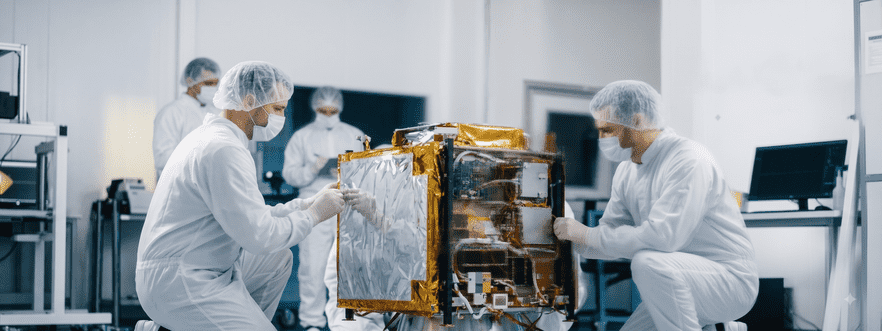

GalaxEye has stopped thinking like a satellite startup. With its acquisition of StarOps, it is starting to look like a space manufacturer.
The Infosys-backed Bengaluru company has acquired StarOps, a spacecraft engineering firm also based in Bengaluru, pulling much of satellite building under its own roof. Terms were not disclosed. The signal, though, is loud. GalaxEye wants to own the hardware, the engineering and the supply chain behind its satellites, not rent them.
Standing matters in this business, and GalaxEye has it. It is one of just 18 startups formally cleared by the Indian National Space Promotion and Authorisation Centre, the government body that authorises private players to operate in space. India counts around 440 registered space technology startups. Making that authorised shortlist is a signal the company clears a regulatory and technical bar most of the field has not.
A team that has aimed at the Moon
Start with the people. The deal brings in roughly 25 to 30 engineers with an unusual pedigree. Several cut their teeth at TeamIndus, the private venture that competed for the Google Lunar XPRIZE and remains one of India's boldest attempts at private spaceflight. They worked on its lunar lander and rover programmes.
That is not a line on a résumé. Hands-on spacecraft experience is scarce in India, and most of it sits inside the government programme, not the private sector. A team that has designed real missions from first principles is among the hardest things a young space company can assemble. GalaxEye did it in one transaction.
What a satellite bus actually is, and why owning one matters
Here is a distinction most coverage skips. Every satellite has two parts. The payload is the useful bit, the camera or sensor that does the mission. The bus is everything else: structure, power, propulsion, the onboard computer, the attitude control that keeps it pointed, and the link back to Earth. The payload rides on the bus.
StarOps brings GalaxEye qualified bus platforms across three weight classes.
- 50 kilogram class
- 150 kilogram class
- 250 kilogram class
The word qualified is doing heavy lifting. These platforms have already passed the punishing testing needed to survive launch and operate in orbit. Building and qualifying a bus from scratch takes years and swallows budget. Owning proven ones across three sizes lets GalaxEye build small, medium or large satellites without reinventing the foundation each time. It is the difference between building a new car for every trip and owning a reusable chassis.
The Make in India edge
StarOps says it has crossed 66 percent indigenisation across its satellite systems, and in space that figure carries strategic weight well beyond cost savings.
Satellite subsystems are dual-use by nature, close cousins of the hardware that goes into defence and surveillance. That places them squarely in the path of export controls, which foreign governments tighten whenever relations deteriorate. A company that depends on imported critical components is only ever as reliable as its supplier's home government allows, and for anyone serving the Indian armed forces, that dependence can quietly disqualify a bid before it is even made.
Domestic manufacturing changes the equation. By building two-thirds of its systems in India, GalaxEye cuts its exposure to foreign policy shifts it cannot influence, and it aligns with the wider Make in India push to localise critical and strategic production. Indian defence and space procurement increasingly rewards indigenous content, so domestic capability is becoming a commercial edge rather than a compliance exercise. For a company selling all-weather imaging into defence and government channels, that alignment widens the set of contracts it can realistically pursue.
The benefit also compounds. Each critical part brought in-house retires a dependency for good, and for a firm planning a full constellation rather than a single satellite, that saving in cost and risk builds with every unit.
Why optical plus radar is the edge
GalaxEye's imaging advantage sits in its proprietary OptoSAR technology. Optical and multispectral sensors capture sharp, detailed images, but they need daylight and clear skies. Radar imaging works in the opposite conditions, seeing through cloud cover and in complete darkness, though it reads the world differently.
Put both on a single satellite and the gaps disappear. The spacecraft images the same spot regardless of weather or time of day, with no blind windows waiting for clouds to clear. GalaxEye describes it as a world first and holds a patent on the approach. This is why defence, national security and disaster response value all-weather imaging so highly. When it matters most, cloud and darkness are exactly when older systems go blind.
The full-stack logic
Now the pieces connect. GalaxEye already owned the sensor edge through OptoSAR. With StarOps, it owns the spacecraft engineering to carry that payload, the bus platforms to scale it, and a supply chain that is mostly Indian. That is vertical integration, and in hardware it is a genuine moat. A company that controls the whole stack iterates faster, protects margins, and sells complete satellites rather than parts.
GalaxEye's debut mission earlier this year validated its core satellite systems and in-house operations, sharpening the case for building more under its own control. This acquisition is the company acting on that conviction. It is the quiet, capital-intensive work of turning a promising sensor into a full space business, the kind of move that matters more in hindsight than in headlines.