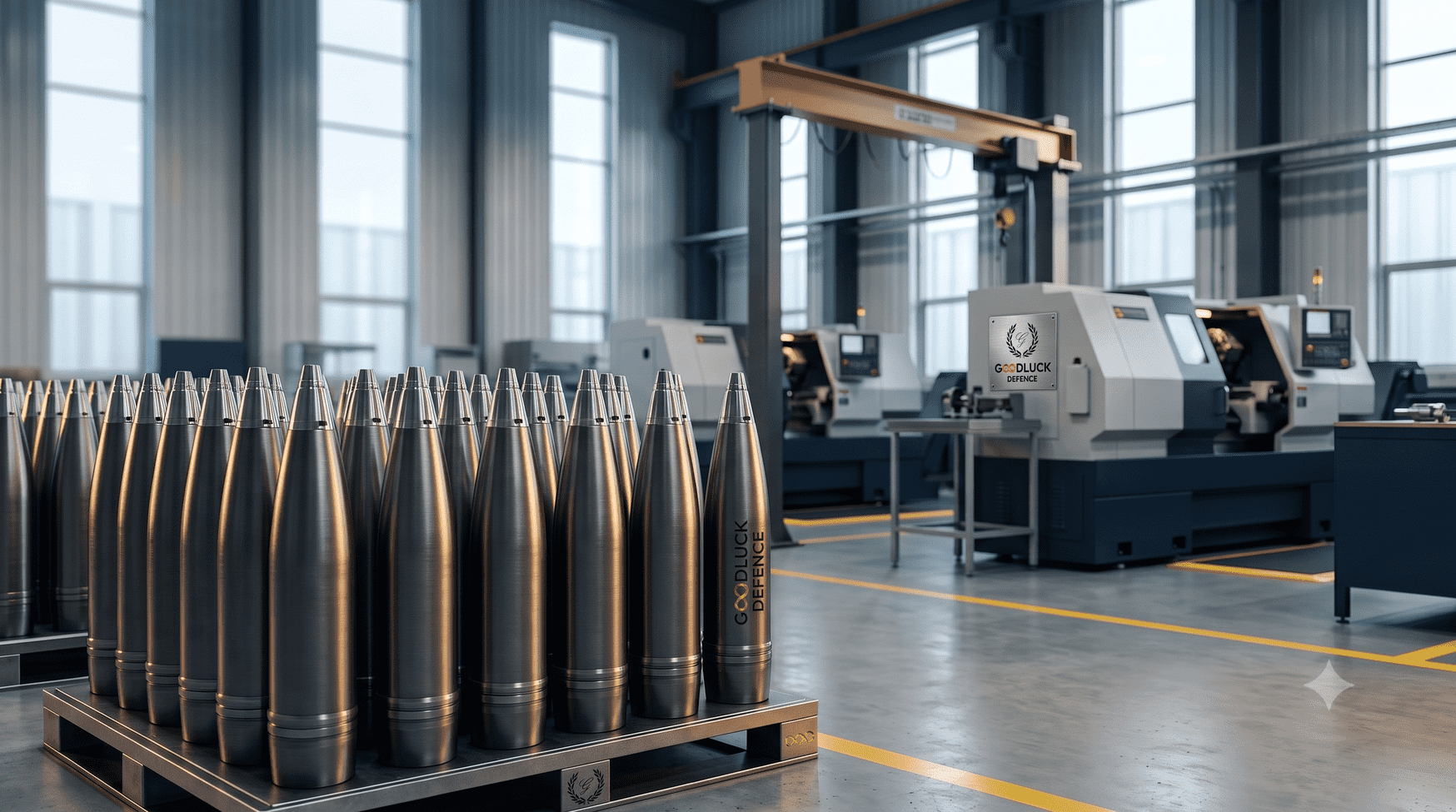

Three years ago Goodluck Defence and Aerospace did not exist. Today it holds an arms manufacturing licence, a defence quality certification, an overseas shipment record and two domestic contracts. It is also selling its premium artillery shell at close to twice the price the market had assumed the product could fetch.
That last point explains a good deal about the ₹283.50 crore of outside capital just committed to the company, at a pre money valuation of roughly ₹1,842 crore.
Understanding why the money arrived starts with the order book.
The pricing everybody modelled wrong
For most of the past year, the reference point for 155mm shell economics came from a listed peer. Sunita Tools disclosed monthly billing of roughly ₹24 crore against 10,000 M107 shells, which implied about ₹24,000 a unit. Nearly every capacity model built for this sector has run off that figure.
Goodluck Defence has now disclosed enough to price its own book, and the numbers land higher.
Its ₹52 crore domestic contract covers 20,000 M107 shells, working out to roughly ₹26,000 a shell. That is a premium to the benchmark on an identical product.
The ₹255 crore contract is the one that resets the model. It covers approximately 50,000 extended range shells, which reach 38 kilometres against 18 kilometres for the M107. Realisation there works out to roughly ₹51,000 a shell, close to double, and it comes off the same line.
Operating margins are similar across both variants, since input costs scale alongside price. The margin percentage does not move, but the absolute rupees do. At a comparable margin, an extended range shell earns close to twice the profit of an M107 shell.
That matters because the constraint in this business is physical rather than financial. A shell plant is measured in units, and those units stay fixed until new capacity is built. The same 1.5 lakh shells a year can produce very different outcomes depending on what runs down the line, and a mix weighted toward extended range work roughly doubles both revenue and profit from identical physical output.
Why the orders keep arriving
Global 155mm consumption continues to outpace what the world can manufacture. European rearmament, Gulf procurement and United States stockpile replenishment are pulling on the same constrained supply base, and management describes supply rather than demand as the limiting factor on the business.
Goodluck Defence has spent the past year removing its own constraints. During the June quarter it received quality assurance certification from the Directorate General of Quality Assurance for 155mm M107 ready to fill shells. That certification is what allows the company to bid for Indian government procurement, and it sits on top of an industrial licence under the Indian Arms Act covering calibres from 105mm through 155mm.
The results are visible in the numbers. First dispatch under a 6 million dollar export contract began in March 2026, and two domestic orders followed. Defence revenue reached approximately ₹80 crore in the June quarter at a 38 percent operating margin, against ₹46 crore across the whole of the previous year, with the plant running at 60 to 70 percent utilisation. Management has guided to ₹300 crore to ₹350 crore for the current year at margins of 30 to 35 percent.
What the money builds
The plant currently makes 1.5 lakh shells a year. The expansion takes it to 4 lakh, at a capital cost of roughly ₹400 crore.
That programme has been waiting on financial closure rather than on demand, approvals or engineering, and management has said as much. This round supplies the equity leg of it. Work is already underway, with commercial output from the new line expected during the 2028 financial year.
The aerospace leg
The second vertical is being built around a gap that is about to open up.
India is moving toward domestic production across several aircraft programmes at once. The C-295 transport is already being assembled here, the Advanced Medium Combat Aircraft has entered its prototype development phase, and components for the Rafale are expected to follow into Indian production. Each of those needs a domestic supplier base beneath it, and that base is thin.
Goodluck India has already built relationships at that level. In September 2025 it signed a tripartite arrangement with AXISCADES Technologies, a listed aerospace engineering firm, and BrahMos Aerospace Thiruvananthapuram, the manufacturing arm of the Indo Russian missile venture, pairing its own defence grade manufacturing with engineering, systems integration and electronics capability.
Goodluck Defence is positioning as a component supplier into these programmes, selecting parts where domestic share can realistically be won. The enabling asset is a rolling mill planned within the aerospace expansion. Management has indicated the same equipment will also be capable of producing outer bodies for space launch vehicles, which opens a third end market alongside artillery and aircraft.
Earlier group commentary placed the aerospace vertical at around ₹200 crore within a ₹1,000 crore ambition for the subsidiary, and that timeline moves in step with the shell expansion.
What compounds from here
The two levers in this business are independent of each other. Capacity is being taken from 1.5 lakh shells to 4 lakh. Realisation on the premium variant is already running at roughly double what the sector had assumed. Neither depends on the other, and they do not add together, they multiply.
Management has guided to a listing roughly 18 months out, subject to approvals, on the reasoning that a business scaling at this pace should carry its own balance sheet rather than lean on the parent's.
That timing is worth sitting with. The expanded line is expected to reach commercial output in roughly the same window. On current guidance, Goodluck Defence would arrive at the market with its capacity already built rather than still being promised.