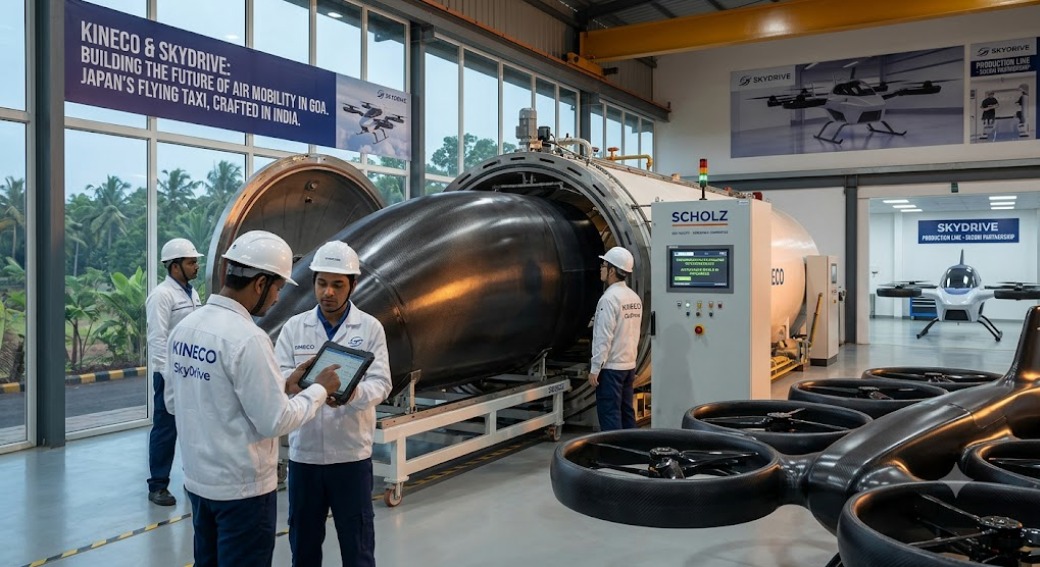

At Pilerne in Goa sits a newly installed Scholz autoclave, three metres wide and twelve metres long. It is one of the largest aerospace composite processing systems in India.
Last week at the Farnborough International Airshow, a Japanese aircraft company announced it would use that machine to build the body of its flying taxi.
The company is SkyDrive. The partner is Kineco Limited.
Small announcement. Long shadow.
What was announced
SkyDrive builds compact electric vertical take off and landing aircraft. Its production model, the SD-05, is a three seat machine lifting on twelve rotors, with no wings and no tilting parts.
Kineco will develop and manufacture the composite aerostructures for it. The scope runs across tool design, prototype development, certification support and serial production readiness. Work will run on that autoclave in Goa.
It is the first dedicated production programme for an electric air taxi that Kineco Aerospace has taken on.
This is not an order
No contract value. No volumes. No delivery schedule. This is a development agreement, and nothing from it reaches Kineco's revenue line this year.
That is not the point.
In aerospace, qualification comes before money. Clearing the bar to supply a flight critical structure takes years of certified facilities, traceable materials and audited process. Once a supplier is on a programme, removing them is expensive. What Kineco won here is position, not revenue.
The credential stack
Look at the last two years.
- October 2024: bought out the remaining stake in its joint venture with Kaman Aerospace Group of the United States, a business shipping consoles into the Boeing P-8 Poseidon programme
- June 2025: signed a multi year supply chain agreement with FACC AG of Austria at the Paris Air Show, opening with a ten month qualification phase
- July 2026: signed with SkyDrive at Farnborough
Three global principals, three geographies, three flight platforms. Each one is an independent party certifying that a company in Goa can build parts that fly.
Japan is building an air mobility supply chain in India
Kineco is not SkyDrive's first Indian supplier. In January 2026 a Bengaluru engineering firm was contracted to design the electrical wiring interconnection system for the same aircraft. Two of the most demanding work packages on a Japanese air taxi now sit in India.
This is structural, not cost arbitrage. Japan has a thin domestic base in advanced composites and an ageing industrial workforce. India has capacity and a state that wants aerospace manufacturing badly.
We expect this to become a pattern rather than a one off, with more Japanese and European programme work landing here over the next three to five years.
Where SkyDrive stands today
SkyDrive is further along than most assume. It agreed the General Certification Plan with the Japan Civil Aviation Bureau in March 2026, received Approved Design Organization certification in April, and flew the aircraft at one hundred kilometres per hour in June. Cumulative orders stand at 427 aircraft, split between 354 pre-orders and 73 basic purchase agreements, including twenty units for a Dubai helicopter operator. Production has run at a Suzuki Motor Corporation plant since March 2024, with Suzuki also an investor. Commercial operations are targeted for 2028.
What it means for a Kineco investor
Kineco crossed a ₹3,000 crore consolidated order book earlier this year on the back of Vande Bharat Sleeper interiors work. Financial year 2025 revenue was roughly ₹245 crore. Its credit rating was upgraded to BBB minus with a stable outlook in November 2025.
Against that base, SkyDrive adds nothing material to near term numbers. It adds optionality and evidence.
The optionality is simple. If SkyDrive certifies and scales, Kineco holds an incumbent position on a production aircraft with more than four hundred units already spoken for.
The evidence matters more. A company still dominated by Indian railways revenue keeps getting chosen by global aerospace principals for flight critical work. Rail pays the bills. Aerospace is where the margin, the exports and the eventual multiple live.
Read this not as a contract win but as a scorecard update on whether the aerospace thesis is working. On that measure, the last twenty four months have gone Kineco's way.
This article is for information purposes only and does not constitute investment advice. Unlisted securities carry liquidity, valuation and disclosure risks. Investors should conduct independent due diligence before taking any position.