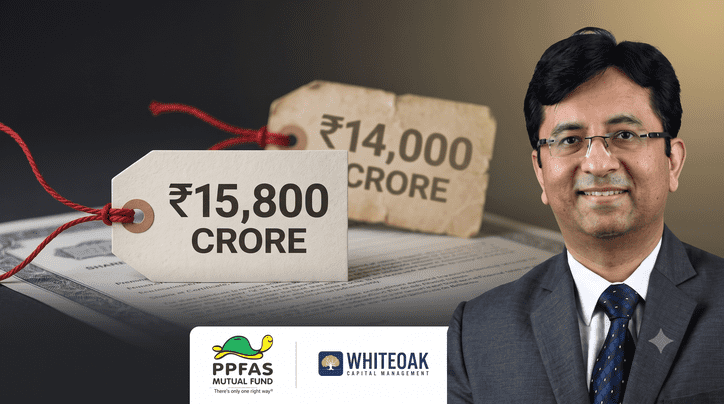

Rajeev Thakkar has spent two decades telling investors that the best move is usually no move. This month, the man behind India's most closely followed equity scheme sold. Not much. About 0.33 percent of Parag Parikh Financial Advisory Services, the unlisted parent of PPFAS Mutual Fund, for roughly ₹52 crore.
The cheque is small. The number behind it is not. The buyer is an alternative investment fund from WhiteOak Capital, the house founded by Prashant Khemka, whose close-ended funds hunt for positions before companies reach the public markets. The price values PPFAS at almost ₹15,800 crore. Neither side has officially confirmed the transaction.
Two prints, three weeks apart
For years, PPFAS was a business everyone admired and nobody could price. July priced it twice.
- Early July: promoters Neil Parikh and Khushboo Parikh sold about 1 percent to Avendus Future Leaders Fund III for ₹140 crore, valuing the company near ₹14,000 crore
- Late July: Chief Investment Officer Rajeev Thakkar sold about 0.33 percent to WhiteOak Capital's alternative investment fund for about ₹52 crore, valuing it at almost ₹15,800 crore
That is a 13 percent step-up in roughly three weeks. Two different sellers, two different institutional buyers, and the second buyer paid more. Demand is doing the talking, not sellers in a hurry.
What the price actually says
PPFAS managed nearly ₹1.61 lakh crore as of June 30, with the flagship Parag Parikh Flexi Cap Fund alone at ₹1.42 lakh crore. Against that base, ₹15,800 crore is just under 10 percent of assets under management.
Here is the interesting part. SBI Funds Management, India's largest asset manager with mutual fund assets of roughly ₹12.5 lakh crore, listed on July 21 at an issue valuation of about ₹1.17 lakh crore, a little over 9 percent of those assets. Two institutions have now independently paid nearly the same share of assets for PPFAS that public investors just paid for the industry leader.
On earnings, a premium is visible. Revenue from operations rose to ₹596 crore in financial year 2026 from ₹423 crore, and net profit to about ₹348 crore from ₹248 crore. The WhiteOak print implies around 45 times trailing profit, against roughly 38 times for SBI Funds Management at issue. In our view, that gap is the price of growth and a fee-rich, all-active equity book. The discount runs the other way too: the Flexi Cap Fund is close to 90 percent of assets, and the shares remain unlisted and illiquid. A buyer at 45 times earnings is accepting both.
Who sold, and who very much stayed
Look at the shareholding as of March 31, 2026, and the story sharpens.
- Neil Parikh: 41.98 percent
- Geeta Parikh: 18.26 percent
- Sahil Parikh: 14.28 percent
- Rajeev Thakkar: 6.21 percent
The Parikh family held nearly 74.5 percent, and the four largest shareholders together controlled 80.73 percent. Even after both July deals, the family stays above 73 percent, and Thakkar remains the largest non-promoter holder with close to 5.9 percent, worth around ₹930 crore at this price. These are trims, not exits. Nobody handed over control.
The 2030 thread
There is a reason institutional money is walking in now. At its unitholders' meet last November, the management indicated a listing around 2030, once the current cycle of employee stock options has fully vested, since an earlier float would saddle employees with a heavy tax bill.
Read the buyer list in that light. Avendus Future Leaders Fund III backs late-stage leaders headed for the public markets, with Lenskart, Juspay and Veritas Finance already in its book. WhiteOak's close-ended funds are built for pre-listing entries. Two vehicles designed for exactly this trade have entered roughly four years before a stated listing window. As we read it, the smart money is not debating whether PPFAS lists. It is positioning for when.
What this means in the unlisted market
For unlisted market participants, July delivered something PPFAS never had: credible reference prices set by arm's length institutional cheques rather than dealer quotes. ₹14,000 crore, then ₹15,800 crore, inside a single month.
A caution belongs here. Two negotiated deals do not make a liquid market. Free float is thin, the family controls supply, and quotes can run well ahead of, or behind, the last institutional print. What the July numbers do tell you is simpler: one of the most respected franchises in Indian asset management finally has a price, the price rose on the second trade, and the people closest to the business kept almost all of their shares. That is rarely an accident.